Art Deco Porcelain and Ceramic Tile for Floors and Walls
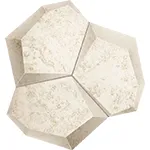
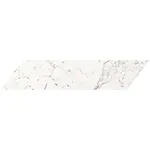
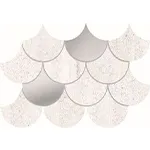
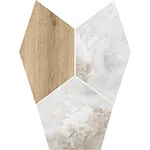
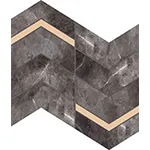
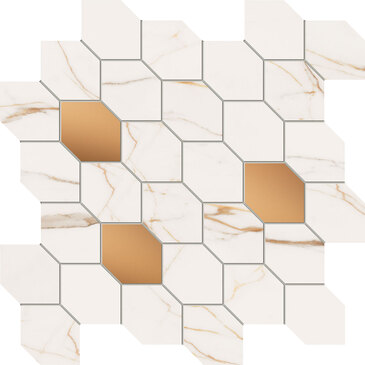
Deco surfaces run on repetition and contrast: squares set against squares, chevrons, narrow strips of trim, and panels that build one large figure out of separate pieces. Balance Stone 12x11 is a matte-and-polished porcelain chevron, and the same series returns as a 12x12 mosaic in matte/polished and all-polished versions, so sheen alternates within a single sheet. Multi-element decors carry the walls: Alabaster Shine Leaves spreads across eight 24x48 matte porcelain elements that assemble into a 96x96 panel, and All in white Forest scales to 48x84 in matte ceramic.
Field tile stays deliberately quiet. Alabaster Shine Beige 24x48 matte porcelain and Bafia White 12x24 semi-matte with a glimmer face give the pattern somewhere to sit.
Choosing Art Deco Tile
Pattern work punishes layout error, so start with format. Multi-element decors ship as numbered pieces, A1 through B4 on Alabaster Shine Leaves, and must be set in sequence, which means ordering the complete set with no substitutions. A checkerboard floor wants square tile in two colors and a rectified edge, cut true after firing, so the joint can close down and the grid stays sharp; pressed tile with its softer edge needs a wider joint and blurs the effect. Faces that mix matte and polished, as Balance Stone does, read differently from every angle, so judge a sample under the room's own light.
Where to Use Art Deco Tile
Bathrooms absorb this style most easily. A black and white square floor under a plain wall is the standard deco move, and 12x24 decors work as a band above a vanity or across a shower back wall. Porcelain in 24x24 and 24x48 handles entries, hallways and powder-room floors. Assembled panels are wall-only pieces, suited to a stair hall, the space behind a tub, or one figure on a living-room wall. Strip and listello trim caps a wainscot. Metallic accents sit under metallic tile.
Related styles: vintage tile, glamour tile, mid century modern tile and classic tile.