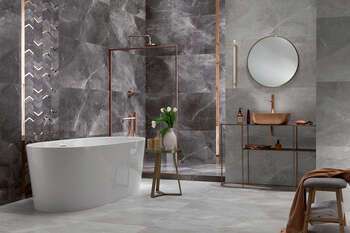
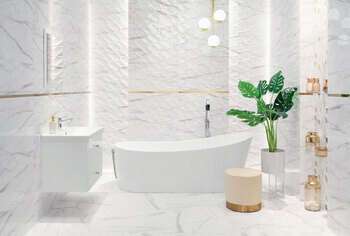
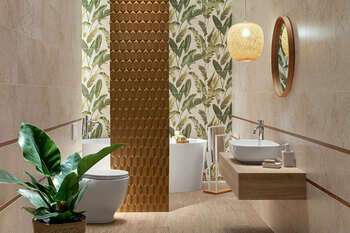
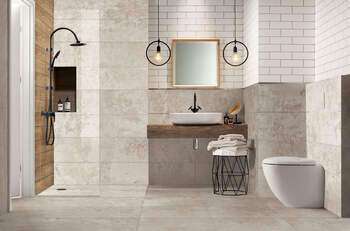
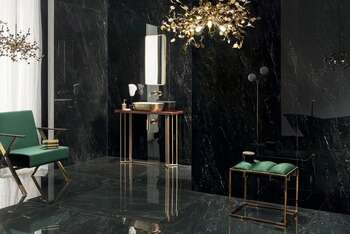
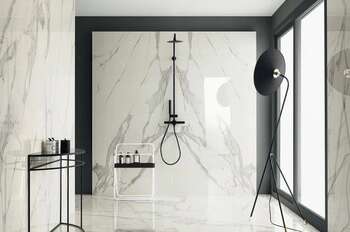
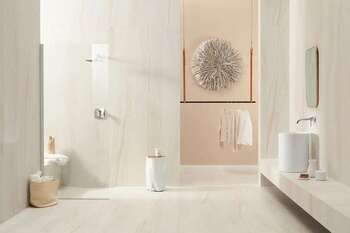
Marble look tile is pressed porcelain or ceramic, printed and glazed to copy the color and veining of quarried marble. It is not stone. The body is fired clay, so it does not etch when lemon juice or wine sits on it, it does not need sealing, and it will not want re-polishing the way a marble slab does. Porcelain also absorbs very little water, which is why it goes into showers and onto floors where real marble tends to stain. What you give up is the depth of a cut slab; what you get back is a surface you clean with ordinary tile cleaner.
Polished faces reflect light and read closest to honed marble, but they show footprints and get slick when wet. Matte and satin faces hide dust and give more grip. Lappato, a partial polish, sits between the two. Rectified tiles are cut square after firing, so they set with a narrow joint and the veining carries across that joint more convincingly. Ranges printed from several different faces vary the pattern tile to tile, so dry-lay a few boxes and shuffle them before anything is fixed. Bigger formats such as 24x48 and 48x48 cut the number of joints across an open floor.
Bathroom floors and walls, shower surrounds, kitchen backsplashes, entry halls and open living floors. Gloss wall tile suits a backsplash or a vanity wall; satin and matte porcelain suit floors that take traffic. Browse all porcelain tile or the wall tile range to compare marble against concrete, stone and wood effects.
Ranges in this section: Specchio Carrara white Carrara look porcelain, Blackwall black marble look tile, Dorado Stone gold-toned glossy wall tile, Regal Stone bold veined porcelain, Tender Stone cream satin porcelain, Floral Stone and Neutral marble looks.